
 |
| CGI color image recreated from black and white magazine ad |
Or titles to that effect, anyway. Whether it's called The Monty Python Instant Record Collection or The Instant Monty Python CD Collection, none of them are a complete collection of all the Monty Python albums. Though one comes close.
To be fair, none of them claim to be a complete collection. The first Monty Python Instant Record Collection came out in 1977, in the days before "complete works" box sets were an industry standard. It was just a joke title for a greatest hits package. In fact it was subtitled The Pick of the Best of Some Recently Repeated Python Hits Again, Vol. II.
 Now that's a joke. Even by 1977 Python had been repeated -- certainly on television -- so many times that fans already knew all the sketches. Using words like The Pick Of, The Best Of, Recently Repeated, Again, and Volume Two was just Python's way of saying, hey, there's nothing new in this package but here it is, we know you're still gonna buy it. (And there was no volume one. They called it volume two as part of the joke, just to drive the point home that this was the same material you've gotten from Python again and again and again.)
Anyway, around the time CDs began to replace LPs (late 1980s - early 1990s) there grew a new market for old records: complete box sets. Teenagers of the 70s who spent all of their youth and all of their lawn-mowing and babysitting dollars building up their Beatles collections and Pink Floyd collections and Monty Python collections were now grown-ups with careers and families and meetings and conferences to go to. They still wanted their old records but they wanted them in the new CD format. They didn't want to go to the record store every week and buy their collections again, one at a time. They (we) said, "Just give me everything I already own on vinyl in one-lump-CD-sum!"
Hence the box set.
 This time -- the 1990s -- Python had a true reason to present a package called The Instant Monty Python CD Collection. This time it was not a joke. It really was an instant CD collection. With one purchase you suddenly had 8 Monty Python albums (spread over 6 discs). Certainly an instant collection, but at the same time, certainly not complete, as it was missing the first Monty Python's Flying Circus album, and the US-only release Live at City Center (which was fine, because the box set included the UK-only Live at Drury Lane which is very similar to City Center.)
Obviously issues of licensing and ownership and labeling come into play when a company or a group is compiling a greatest hits collection or a box set, and The Instant Monty Python CD Collection contained all the Python material that was owned by Virgin Records at the time (still is I believe). So I fully understand the reasoning MPFC and L@CC were left out of the box set. (They weren't owned by Virgin. BBC owned the first one, and Arista owned the live one.)
But there, let us begin in 1977 and plough our way through the series of releases with Monty and Python and Instant and Record and/or CD and Collection in their titles, shan't we?
First of all, here is a lineup of the LPs and CDs in question. I shall comment upon them one at a time. Go on. Humor me. I've got nothing else going on today and it's raining cats and dogs out there...
1977 - The Monty Python Instant Record Collection
Charisma Records CAS-1134
Single LP Deluxe Gatefold Cover
The original Monty Python Instant Record Collection (take note that the name Monty Python comes before the word Instant on the original LP, as opposed to the later box set where Instant comes before Monty Python. Different titles, different collections.)
This version of The Monty Python Instant Record Collection was the first collection of greatest hits ever released by the group. The title implied that, in one record, you would have all the best bits from all the Charisma-labeled Monty Python records: Another Monty Python Record, Monty Python's Previous Record, Monty Python's Matching Tie and Handkerchief, Monty Python Live at Drury Lane, and The Album of the Soundtrack of the Trailer of the Film Monty Python and the Holy Grail.
There are no tracks from the original BBC television soundtrack album Monty Python's Flying Circus and no tracks from Arista's US-only release Monty Python Live at City Center.
Since this record came out in 1977, there are no cuts, obviously, from Monty Python's Contractual Obligation Album, which was released in 1980, and no cuts from either of the movie soundtracks for the yet-to-be-released Monty Python's Life of Brian (1978) and Monty Python's Meaning of Life (1983).
It is doubtful that any greatest hits collection put out prior to Virgin Records' 1987 purchase of the Charisma Monty Python catalog would include tracks from these movies anyway, since the Brian soundtrack was released on Warner Bros. and Meaning of Life was issued on MCA.
But by the time Virgin Records released the 1994 Instant box set, the Life of Brian and Meaning of Life soundtracks were under their ownership and thus included in the box. As of this posting, to the best of my knowledge, the original Flying Circus BBC soundtrack and Arista's Live at City Center are the only two releases not under Virgin's ownership.
Another reason for the title of this 1977 collection has to do with the packaging.
Oddly, Terry Gilliam is not mentioned anywhere on the packaging as Designer, though according to Palin's diaries -- and the pure look and feel of the package -- all fingers point to T.G.
"Design Production" is credited to AD Design on the album's inner sleeve, and even the "Hands Photograph" gets credited to John Sims. Perhaps Gilliam was acting as art director at this point and merely assigned the project to outside sources.
 But the packaging is truly from the mind of Gilliam.
Open the package and you'll see it's more than just your standard gatefold cover. It keeps folding and unfolding until -- voila! -- you've got a cardboard sculpture: a 12 inch x 12 inch x 12 inch cube that, when placed on your shelf, looks exactly like a full size LP record collection, 65 titles in all -- truly an Instant Record Collection. Well, not truly, I guess. More like falsely an Instant Record Collection.
To be fair, none of them claim to be a complete collection. The first Monty Python Instant Record Collection came out in 1977, in the days before "complete works" box sets were an industry standard. It was just a joke title for a greatest hits package. In fact it was subtitled The Pick of the Best of Some Recently Repeated Python Hits Again, Vol. II.

Anyway, around the time CDs began to replace LPs (late 1980s - early 1990s) there grew a new market for old records: complete box sets. Teenagers of the 70s who spent all of their youth and all of their lawn-mowing and babysitting dollars building up their Beatles collections and Pink Floyd collections and Monty Python collections were now grown-ups with careers and families and meetings and conferences to go to. They still wanted their old records but they wanted them in the new CD format. They didn't want to go to the record store every week and buy their collections again, one at a time. They (we) said, "Just give me everything I already own on vinyl in one-lump-CD-sum!"
Hence the box set.
Obviously issues of licensing and ownership and labeling come into play when a company or a group is compiling a greatest hits collection or a box set, and The Instant Monty Python CD Collection contained all the Python material that was owned by Virgin Records at the time (still is I believe). So I fully understand the reasoning MPFC and L@CC were left out of the box set. (They weren't owned by Virgin. BBC owned the first one, and Arista owned the live one.)
But there, let us begin in 1977 and plough our way through the series of releases with Monty and Python and Instant and Record and/or CD and Collection in their titles, shan't we?
First of all, here is a lineup of the LPs and CDs in question. I shall comment upon them one at a time. Go on. Humor me. I've got nothing else going on today and it's raining cats and dogs out there...
 |
| Between 1977 and 1994, three different collections have shared the title Instant Record Collection (both LP and CD versions shown above. no LP version of the box set was ever released) Click picture to enlarge. |
 |
| Although there was no LP version of The Instant Monty Python CD Collection, there was indeed a box set of vinyl LPs released in Australasia called All Of The Worst of Monty Python. (I've seen this on eBay with anywhere from 5 to 7 LPs. Based on the cover, it contained at least 6.) |
1977 - The Monty Python Instant Record Collection
Charisma Records CAS-1134
Single LP Deluxe Gatefold Cover
The original Monty Python Instant Record Collection (take note that the name Monty Python comes before the word Instant on the original LP, as opposed to the later box set where Instant comes before Monty Python. Different titles, different collections.)
|
| The first issue of The Monty Python Instant Record Collection, 1977. Package design by Terry Gilliam. Note the "sliced records" on the cover all bear The Famous Charisma Label. |
 |
| Detail shows the "sliced records" to be of the original Charisma mad hatter design. |
There are no tracks from the original BBC television soundtrack album Monty Python's Flying Circus and no tracks from Arista's US-only release Monty Python Live at City Center.
Since this record came out in 1977, there are no cuts, obviously, from Monty Python's Contractual Obligation Album, which was released in 1980, and no cuts from either of the movie soundtracks for the yet-to-be-released Monty Python's Life of Brian (1978) and Monty Python's Meaning of Life (1983).
It is doubtful that any greatest hits collection put out prior to Virgin Records' 1987 purchase of the Charisma Monty Python catalog would include tracks from these movies anyway, since the Brian soundtrack was released on Warner Bros. and Meaning of Life was issued on MCA.
But by the time Virgin Records released the 1994 Instant box set, the Life of Brian and Meaning of Life soundtracks were under their ownership and thus included in the box. As of this posting, to the best of my knowledge, the original Flying Circus BBC soundtrack and Arista's Live at City Center are the only two releases not under Virgin's ownership.
Another reason for the title of this 1977 collection has to do with the packaging.
"The cover of the Instant Record Collection was greatly approved of. Thank you Terry Gilliam (though I don't think anyone got around to saying that.)"
~ from the December 2, 1977 entry of Michael Palin's Diaries
"Design Production" is credited to AD Design on the album's inner sleeve, and even the "Hands Photograph" gets credited to John Sims. Perhaps Gilliam was acting as art director at this point and merely assigned the project to outside sources.

Open the package and you'll see it's more than just your standard gatefold cover. It keeps folding and unfolding until -- voila! -- you've got a cardboard sculpture: a 12 inch x 12 inch x 12 inch cube that, when placed on your shelf, looks exactly like a full size LP record collection, 65 titles in all -- truly an Instant Record Collection. Well, not truly, I guess. More like falsely an Instant Record Collection.
 |
| When completely opened, The Monty Python Instant Record Collection looks like a realistic set of 65 LPs. |
"Terry G. is very enthusiastic about the cover design for the new 'Best Of' album... He wants material for the cover -- blurb of any kind -- and lots of false titles for LPs..."
~ from the September 21st 1977 entry of Michael Palin's Diaries
Whether Michael alone was asked by Terry G. to contribute the above mentioned "blurb" and "lots of false titles," or if it was a project for which all the Pythons were asked to contribute, is unclear. Either way, the blurbs they came up with appear on the inner sleeve -- or bag -- of The Monty Python Instant Record Collection:
The text on the inner bag seems very Palinesque, but the Pythons actually had a friendly agreement that none of them were to receive individual writing credits; "Monty Python" was always to be a group experience wherein all shared the wealth.
Meanwhile, embedded in the grooves of The Monty Python Instant Record Collection record, original UK version, are 23 cuts, previously released on all the earlier Charisma Monty Python releases, and one never-before-released track: Side Two, Track Four is an audio version of The Summarize Proust Competition sketch from season three of the television series.
Oddly this sketch appears on the album without fanfare or even mention of any kind. You'd think the album cover would've bore a large red label, "Warning: Contains a never-before heard version of the Summarize Proust sketch!"
Not only is it a bonus having this sketch appear as a surprise in the middle of this greatest hits package, but it also allowed many Python fans to hear the unexpurgated version for the first time!
The Summarize Proust Competition has become legendary due to a censorship edit upon its original airing on Monty Python's Flying Circus in 1973. In the sketch -- a game show parody in which contestants have 15 seconds to summarize Marcel Proust's series of seven novels entitled A la Recherche Du Temps Perdu (In Search of Lost Time) (circa 1913-1927) (yes, I googled that!) (but only for the proper spelling!) -- host Arthur Me (Terry Jones) interviews one of the contestants, Harry Baggit (Graham Chapman) and asks him what his hobbies are, outside of summarizing Proust. The infamous response from Mr Baggit -- as originally filmed -- was "Strangling animals, golf, and masturbating."
The BBC, meanwhilst, broadcast the joke but edited the masturbation reference: "Strangling animals, golf..." Pause. Outrageous laughter from the studio audience!
From Monty Python: Almost the Truth: The Lawyer's Cut:
I have seen three different edits of this sketch on TV over the years: one with no edit at all, with "and masturbating" intact; another with the offending hobby silenced out, but no splice in film; and a third variation where the audio has been spliced and rearranged, despite it being out of sync with the film, in which Graham states his hobbies as "Golf... and... Strangling animals..." Someone took some time to edit the audio track so "strangling animals" gets the big laugh rather than "golf." An improvement, IMHO. And I believe my A&E VHS video collection of the complete MPFC includes the "silenced" version, but I haven't watched it in years. (I still haven't got the entire series on DVD.)
Anyway, The Monty Python Instant Record Collection, original UK version, is the only place you can get that sketch complete and intact. Albeit audio only.
The Summarize Proust sketch was probably originally recorded for Monty Python's Previous Record, due to the fact that the booklet for the original CD release of that album includes a music credit for Proust Song by Fred Tomlinson, which doesn't seem to appear on the record anywhere. And indeed The Fred Tomlinson Singers -- posing as he Bolton Choral Society under the supervision of Superintendent McGough -- perform "Proust in his first book, wrote about, wrote about..." in the Summarize sketch. So... there's that.
"He must've let himself down a bit on the hobbies.
The Rest of the Contents of The Monty Python Instant Record Collection (Original UK Version)
Side A
 |
| The inner bag for MPIRC was a simple black and white, one-sided affair with title, credits, naked dancing girl, photo of the group circa 1977 with Cleese barely visible in the shadows, the famous Charisma logo, and two comedic blurbs, probably penned by Palin: Where Are They Now? and Where To Go If You Have Got A Lot of Money. |
The text on the inner bag seems very Palinesque, but the Pythons actually had a friendly agreement that none of them were to receive individual writing credits; "Monty Python" was always to be a group experience wherein all shared the wealth.
Here, then, are all 65 faux titles included on
The Monty Python Instant Record Collection
 |
The back cover design for the Instant Record Collection is meant to look
like... well... an instant record collection, with 65 faux spines |
The Monty Python Instant Record Collection
Rock and Roll Is Here to Stay Again!
The Beatles Chauffers Live!
Running Songs and Surrendering Ballads:
The Massed Bands of the Queen's Own Cowards (or Some of Them)
ETERNALLY YOURS:
The Massed Windscale Marching Scientists
Ron Simon and Geoff Garfunkel
Live from the Tennis Club Purley
Together Again - Frank and Ifield
MY BRAIN HURTS - The Moron Tabernacle Choir
The Milkman Whistles Stockhausen - 'A' Milkman
When We're Apart - The Legs
FRIDAY NIGHT IS BATH NIGHT - J.P.Gumby
When the Chickens Are Asleep - Ramon and Ted
NIXON'S SOLID GOLD DENIALS
Norma Shearer Whistles Duane Eddie
TEACH YOURSELF POWER
The Best Bits of Rolf Harris
Monty Python's Best Sketches Beginning With 'R'
Hitting Ourselves with the Little Curved Bit on the End of the Shaving Brush
- Eric and the Loonies
My Brain Hurts and Other National Front Marching Songs
THE BEST OF THE OSMOND'S TEETH - vol XI
An Evening with Martin Bormann
(and the Trio los Paraguayos)
A NIGHT IN CASABLANCA - The Everly Sisters
Ron Simon and Geoff Garfunkel
Live from the Tennis Club Purley
Give Me the Moonlight and the Goats - Ramon and Ted
A MAN WHO ONCE SOLD PAUL McCARTNEY A NEWSPAPER - LIVE!
RAW POWER PUNK KILL BLAST THROTTLE DESTROY
- Clodagh Rotten
The Dave Clark Five's War Speeches
The Best of Raggae Maudling (Rastatory Label)
The Wonderful Sound of Hip Injuries
Beethoven's Punk Symphony, in B Flat - "The Stinking Bastard" (Bandages Supplied)
The Horrid Brothers Kill Anyone in Sight
PARTY TIME Princess "Piano" Margaret
Young, Gifted, Black, and Furry - Ramon and Ted
MY WAY or ELSE - Frank Sinatra
It's All Over My Friend
- Earl K Vomit and the Meatabolic Processes
John, Paul, George, and Ringo - The Davenport Brothers
Scottish Airs - the Hamish McFart Singers
I Left My Pacemaker In San Francisco - Dr DeBakey
More Songs From the Goole and District Catholic River Wideners Club
Bernard Delfont Live at the Bank Next to the London Palladium
Bright Lights, Soft Music, Live Goats - Ramon and Ted
FOOTLOOSE and FANCY FREE - Britt Eckland
a NIGHT on the TOWN - Britt Eckland
SMILER - Britt Eckland
GASOLINE Alley - Britt Eckland
NEVER a DULL MOMENT - Britt Eckland
an OLD RAINCOAT WON'T EVER LET YOU DOWN - Britt Eckland
EVERY PICTURE TELLS a STORY - Britt Eckland
ATLANTIC CROSSING - Britt Eckland
EVERY PICTURE TELLS a STORY - Britt Eckland
RASTAMAN - SIR KIETH JOSEPH (Deleted)
I've Got a Beer Glass Sticking in My Head and Other Rugby Songs
ACCOUNTANTS WORK SONGS
Ruling Songs and Ballads
H.M. The Queen and the Jordanaires
I'm in the Mood for Love and Goats and Chickens - Ramon and Ted
Pet Smells The Beach Boys
MONTY PYTHON TRIES IT ON AGAIN
BOEING BOEING (Cast Album)
BONG BANGY BING!
BANG GOES BOING!
BACK IS BING!
BING IS BACK!
Tom Jones Hits Frank Sinatra While Vic Damone and
Mel Torme Grab Englebert Humperdinck, at Las Vegas
YOU and THE NIGHT and THE MUSIC and THE CHICKEN: Ramon and Ted
GET BACH - The Best of the Welsh Beatles
and
The Pick of the Best of Some Recently Repeated Python Hits Again Vol II
Yeah, but what's really on the real record?
Meanwhile, embedded in the grooves of The Monty Python Instant Record Collection record, original UK version, are 23 cuts, previously released on all the earlier Charisma Monty Python releases, and one never-before-released track: Side Two, Track Four is an audio version of The Summarize Proust Competition sketch from season three of the television series.
 |
| On TV this is what the Proust Sketch looked like. (FYI.) |
Not only is it a bonus having this sketch appear as a surprise in the middle of this greatest hits package, but it also allowed many Python fans to hear the unexpurgated version for the first time!
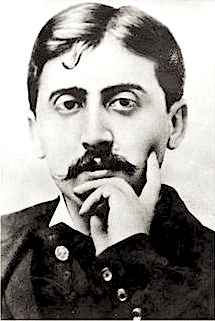 |
| Photo of Marcel Proust circa 1900. Wikipedia. |
The Summarize Proust Competition has become legendary due to a censorship edit upon its original airing on Monty Python's Flying Circus in 1973. In the sketch -- a game show parody in which contestants have 15 seconds to summarize Marcel Proust's series of seven novels entitled A la Recherche Du Temps Perdu (In Search of Lost Time) (circa 1913-1927) (yes, I googled that!) (but only for the proper spelling!) -- host Arthur Me (Terry Jones) interviews one of the contestants, Harry Baggit (Graham Chapman) and asks him what his hobbies are, outside of summarizing Proust. The infamous response from Mr Baggit -- as originally filmed -- was "Strangling animals, golf, and masturbating."
The BBC, meanwhilst, broadcast the joke but edited the masturbation reference: "Strangling animals, golf..." Pause. Outrageous laughter from the studio audience!
From Monty Python: Almost the Truth: The Lawyer's Cut:
"I thought it was also interesting, if you want to be semantic about these things, that strangling animals was seen to be okay, "Oh yeah, that's alright!" But masturbating, "nooo!"
~ Michael Palin re: The BBC's decision to censor the Summarize Proust sketch.
I have seen three different edits of this sketch on TV over the years: one with no edit at all, with "and masturbating" intact; another with the offending hobby silenced out, but no splice in film; and a third variation where the audio has been spliced and rearranged, despite it being out of sync with the film, in which Graham states his hobbies as "Golf... and... Strangling animals..." Someone took some time to edit the audio track so "strangling animals" gets the big laugh rather than "golf." An improvement, IMHO. And I believe my A&E VHS video collection of the complete MPFC includes the "silenced" version, but I haven't watched it in years. (I still haven't got the entire series on DVD.)
Anyway, The Monty Python Instant Record Collection, original UK version, is the only place you can get that sketch complete and intact. Albeit audio only.
The Summarize Proust sketch was probably originally recorded for Monty Python's Previous Record, due to the fact that the booklet for the original CD release of that album includes a music credit for Proust Song by Fred Tomlinson, which doesn't seem to appear on the record anywhere. And indeed The Fred Tomlinson Singers -- posing as he Bolton Choral Society under the supervision of Superintendent McGough -- perform "Proust in his first book, wrote about, wrote about..." in the Summarize sketch. So... there's that.
 |
| The Fred Tomlinson Singers as the Bolton Choral Society, the least successful entrants in the Summarize Proust Competition (they didn't even get to volume one.) |
"He must've let himself down a bit on the hobbies.
Golf's not very popular around here."
~ Eric Idle as the announcer of the Summarize Proust sketch.
The Rest of the Contents of The Monty Python Instant Record Collection (Original UK Version)
Side A
- Introductions (Pleasures of the Dance mix-up from AMPR)
- Alistair Cooke Being Attacked by a Duck (from AMPR) A unique edit of this short bit, it contains a new intro by Michael Palin: "And now for all you lovers of art and culture, here is a rare recording of Alistair Cooke being attacked by a duck..."
- Nudge, Nudge (Live version from L@DL)
- Minister for Overseas Development (Mrs Niggerbaiter sketch from MT&H)
- Constitutional Peasants (Movie soundtrack dialogue from MP&tHG)
- Fish Licence / Eric the Half a Bee (from MPPR)
- Australian Table Wines (from MPPR)
- Silly Noises (from MPPR)
- Novel Writing (from MT&H)
- Elephantoplasty (from MT&H)
- How To Do It (from MPPR)
- Gumby Cherry Orchard (from AMPR)
- Oscar Wilde (from MT&H)
Side B
- Introduction (Exectutive Intro from TAotSTotTotFMP&tHG)
- Argument Clinic (from MPPR)
- French Taunter (Movie dialogue from MP&tHG)
- Summarise Proust Competition (Previously unissued)
- Cheese Emporium (from MT&H)
- Funerals at Prestatyn (from MPPR)
- Camelot (Movie dialogue and song from MP&tHG)
- Word Association Football (from MT&H) Tracks 8 and 9 are linked together with a unique musical interlude of Waltzing Matilda not found on Matching Tie & Handkerchief. Perhaps this was added by Andre Jacquemin to differentiate this grouping of sketches from the MT&H versions of the same. I don't know. Citation needed.
- Bruces Sketch and Philosophers Song (from MT&H) Waltzing Matilda, known as the unofficial national Anthem of Australia, is obviously used here to introduce the Aussie-ness of the Bruces sketch. In the original television version, the Bruces are singing an a capella version of the song at the beginning of the sketch.
- Pet Shoppe (Live version from L@DL)
- Monty Python Theme (Fadeout with Michael Palin voiceover from L@DL)


